Automotive Product Development: Concept to SOP
What is the automotive product development process? It is the gated process that turns a vehicle idea into repeatable series production. The main stages are product definition, concept and design, detailed engineering, prototype validation, production-process validation, Start of Production (SOP) and ramp-up. OEM milestone names differ, while APQP and PPAP provide a shared quality framework for proving that the product and its manufacturing process are ready.
What are the stages of automotive product development?
The concept is only the opening decision. A vehicle programme must turn targets into released designs, prove those designs with simulation and prototypes, build the production process, validate parts and tooling, and then raise output without losing quality. Every gate asks a maturity question: is the evidence strong enough to commit the next block of time and money?
What is the Automotive Product Lifecycle and Development Process?
The product lifecycle of a car (usually called the car development process or vehicle development process) runs from concept through mass production and market launch. It covers four main stages: concept development, engineering and design, validation and pre-production, and ramp-up.
Each stage involves planning, testing and iteration so the vehicle meets the targets set for quality, performance and safety. The lifecycle decides how fast a manufacturer can get a car to market, which is one of the clearest dividers between winners and laggards. This product development cycle is broadly the same for EVs and combustion cars, with a few steps adapted, so what follows applies to almost any automaker. The terminology gets technical, but it holds together once you see how the stages connect. If you want the basics first, read our Automotive 101 article.
The vehicle development stages at a glance
Here are the four phases and ten milestones that take a car from a blank page to the assembly line. The detailed walkthrough follows below.
Phase 1 · Concept Development
Phase 2 · Development
Phase 3 · Series Preparation
Phase 4 · Ramp-Up
Concept Development
1. Product Vision (PV)
The first step in automotive product development is setting a clear product vision. The team studies market trends, customer needs and where the technology is heading, then distils all of it into a direction for the whole project: what this car is for, who buys it, and what makes it worth building. Nothing is engineered yet, but every later decision is measured against the brief set here.
2. Preliminary Product Specification (PPS)
With the vision set, the Preliminary Product Specification turns it into numbers. Technical, cost and timing targets are fixed, and the first feasibility studies test whether they hang together. The big obstacles, a battery package that won't fit, a price target the bill of materials can't hit, surface here, where they are still cheap to solve.
3. Target Agreement (TA)
The concept phase ends with the Target Agreement: a fixed set of targets signed off by all the functions that have to deliver them, from engineering and design to purchasing and finance. Once everyone commits, the budget and resources are released and detailed development can start.
Development
4. Concept Freeze (CF)
At Concept Freeze the technical approach is locked in: platform, powertrain, key dimensions and the main carryover decisions. The plan for how to industrialise it is assessed at the same time. After this gate, changes get expensive fast, because tooling, suppliers and software all build on what was frozen here.
5. Functional Confirmation (FC)
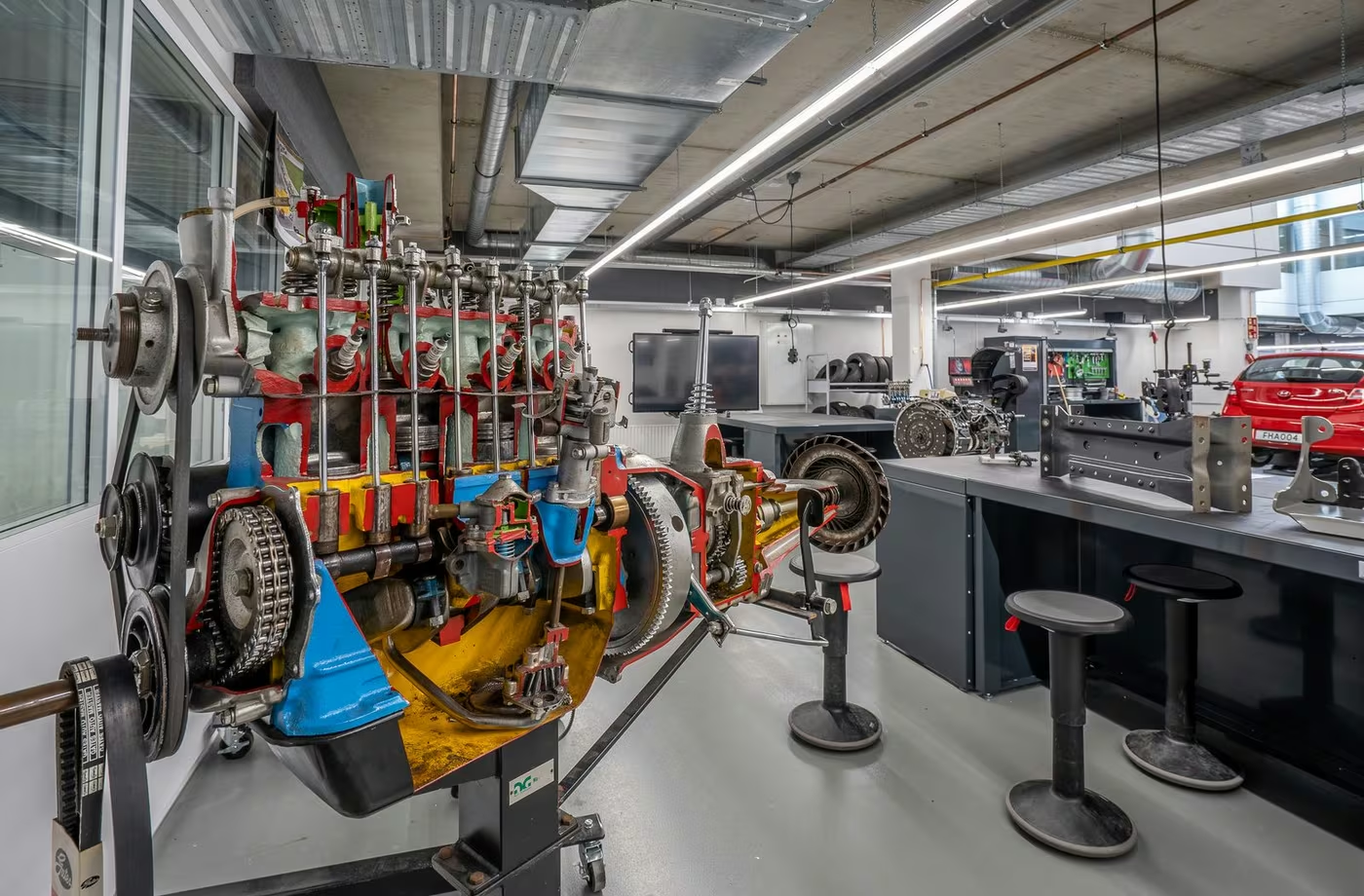
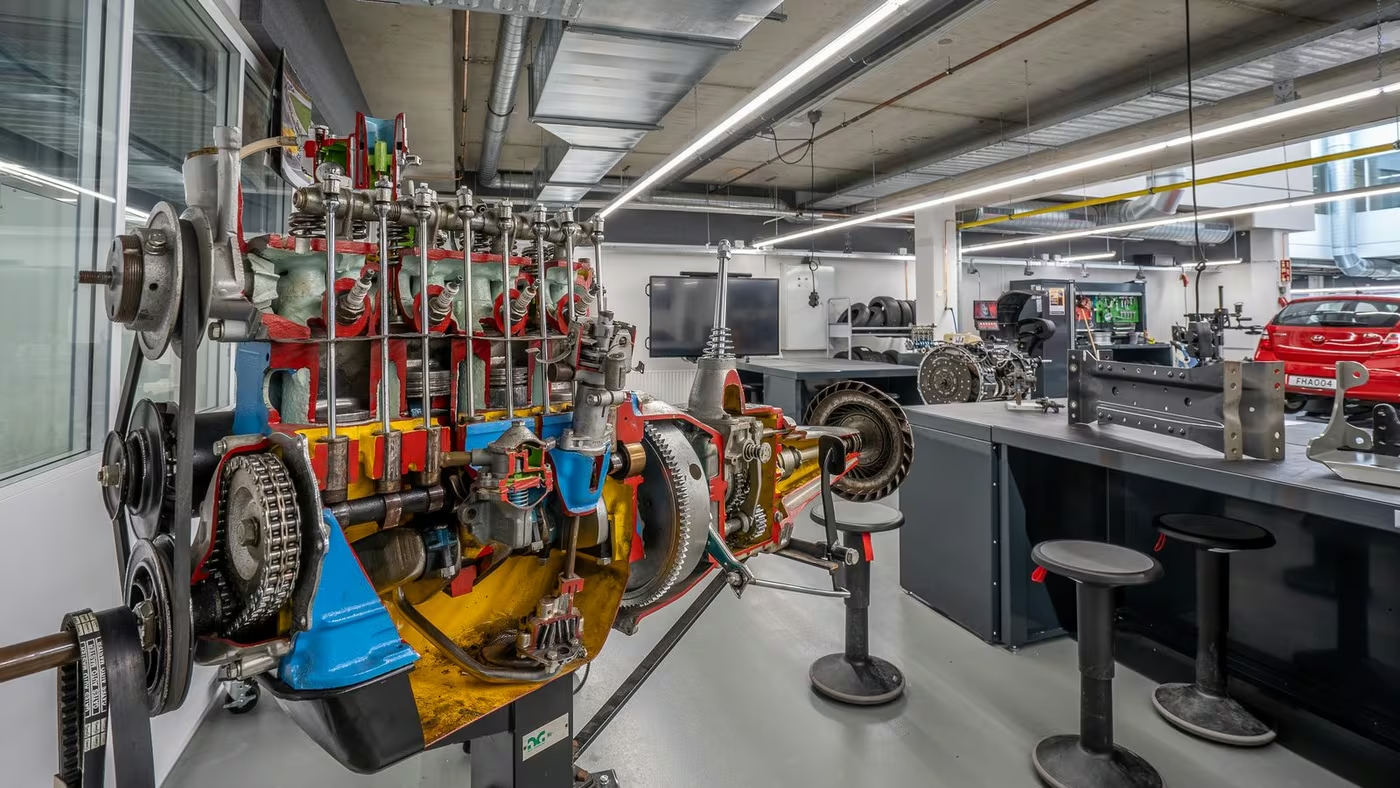
Functional Confirmation is where the design has to prove itself. Using released engineering data, the team runs simulations and tests on prototypes, then works through planned iterations to close the gaps. The aim is to confirm the car meets its functional targets, and that the intended production process can build it, before money is committed to the line.
Series Preparation
6. Production Try Out (PTO)
The first pre-production vehicles are built on the actual production tooling, then painted and tested to verify the manufacturing process. This is where the line itself gets debugged: bad fits, awkward assembly steps and tooling problems are caught and fixed before volume builds start.
7. Pilot Production (PP)
Pilot Production builds a small batch under near-series conditions and runs it through component and whole-vehicle testing. It confirms the car meets its requirements and that the line can produce it at consistent quality, at a steadily rising rate, before the switch to full volume.
8. Launch Sign-off (LS)
Launch Sign-off is the final gate before volume production. The last performance and quality tests are signed off, open issues are closed out, and the plant confirms it can build the car at full rate and quality. Clearing this gate is what releases the car for the market.
Ramp-Up
9. Start of Production (SOP)
Start of Production (SOP) is the day the car enters mass production. The first saleable units roll off the line and distribution to dealers and customers begins. SOP is the milestone the whole programme is planned around, and the official start of the car's market life.
10. Process Stability (PS)
After SOP, the job is to hold quality as output climbs to full volume. The line is monitored closely, early-build issues are fixed, and the process is tuned to lift yield and efficiency. Only once output is stable at the planned rate is the launch considered complete.
How long does vehicle development take?
A clean-sheet vehicle commonly takes several years, but a single benchmark hides the engineering reality. A derivative on an existing platform can reuse crash evidence, powertrain integration, suppliers and tooling concepts. A new platform must create and validate all of them. Software scope, homologation markets, manufacturing footprint and supplier maturity can move the critical path as much as the styling or hardware design.
| Programme type | What can be reused | What usually controls timing |
|---|---|---|
| Facelift | Platform, hard points, most tooling and homologation evidence | Styling release, supplier changes and validation regression |
| Derivative or new body style | Architecture, powertrain and many components | Body tooling, crash variants and production integration |
| Clean-sheet vehicle | Standards, methods and selected components only | Architecture maturity, full validation, tooling and industrialisation |
The five phases of the development process (APQP)
Suppliers and OEMs often map the same journey onto a five-phase framework called APQP, or Advanced Product Quality Planning: plan and define the program, product design and development, process design and development, product and process validation, then launch, feedback and corrective action. The names differ from one company to the next, but the logic is always the same: lock the concept, design the car, design the factory that builds it, prove both work, then ramp up and keep improving. It is the discipline that stops a promising design from turning into an unbuildable one.
The Role of Gates in the Development Process
The milestones above are enforced by gates: fixed checkpoints where every function has to show its work has reached the required maturity before the programme is allowed to continue. They keep engineering, production, purchasing and the rest moving in step. A gate is a decision, not a calendar meeting. Its useful outcomes are release, conditional release with named actions, or stop and recover. If every programme passes with a red issue list and no consequence, the gate is theatre.
- Force product maturity: each gate sets the bar the design and process must clear at that point, so the car gets steadily more finished, not just further along.
- Keep functions aligned: gates are the moment engineering, production, purchasing and quality have to agree the targets are still being met.
- Block premature spend: a phase can't start until the previous gate is passed, which stops expensive work building on an unproven design.
- Adapt to the programme: the spacing between gates is set to the project, tighter for a fast facelift, longer for a clean-sheet platform.
Maturity debt is the cost hidden inside a fast programme
Teams can protect an early milestone by carrying an unresolved decision into the next phase. That may save two weeks today and consume months later. An uncertain battery package delays underbody geometry, cooling, crash structure, wiring and tooling. A late software interface can block several suppliers at once. The work was not removed. It was borrowed from a cheaper phase and repaid in a more expensive one.
Good programmes therefore distinguish an open task from an open architecture decision. A task can have an owner and closure date. An architecture decision creates branches of incompatible downstream work. Gates should expose that difference and test the evidence behind assumptions before tooling, validation fleets and supplier capacity make change painful.
Why software changes the automotive development process
Hardware converges toward one production baseline because tools, parts and homologation need a stable design. Software can continue through release trains, but it still depends on compatible sensors, processors, networks and safety evidence. The answer is not to remove gates. It is to gate the platform and interfaces, then manage application releases against known vehicle configurations. A late feature can move to a later software release. A late change to a braking interface cannot be treated like an app update.
The product lifecycle of a car, in short
Developing a car is a long, multi-stage process built on planning, testing and steady refinement. From the first concept to Start of Production, each stage locks in decisions that are expensive to undo later, which is why the testing and validation work is so heavy. The companies that get faster at it without dropping quality are the ones that gain ground, because development speed is one of the clearest dividers in the industry.
The real process is far more detailed than ten tidy milestones: hundreds of sub-gates and thousands of people working to the same plan. But the shape stays the same: imagine, freeze, validate, build, ramp. Our NIO engineering case study shows how architecture reuse and parallel work can compress that loop without pretending that validation disappears.
SOP, PPAP, APQP and milestones are related, not interchangeable
| Term | What it controls | Practical question |
|---|---|---|
| Gate or milestone | Programme maturity | May the project commit the next spend and release? |
| APQP | Quality planning across product and process | Have risks, controls and validation been planned and closed? |
| PPAP | Supplier production evidence | Can the intended process repeatedly make conforming parts? |
| SOP | Start of series production | Can the plant begin building saleable vehicles under launch control? |
For the supplier-level workflow, documents and submission status, continue with APQP and PPAP explained. For the finished vehicle around those parts, start with how cars work, then follow the digital stack through E/E architecture, the software-defined vehicle and Nvidia automotive computing.
The same gate logic becomes concrete in an automated-driving safety case, where responsibility changes by level, and in the EV battery supply chain, where cell evidence must survive the route from supplier process to finished vehicle.
Primary source, checked July 24, 2026: AIAG's current APQP third edition adds gated management, sourcing, change management, traceability, programme metrics and risk-mitigation planning. Its APQP and Control Plan FAQ documents those changes.
For the factory-side decision in more detail, see what SOP means in automotive manufacturing, including Job 1, pre-series builds and safe launch.
For a reusable overview, download the automotive development process map and milestone CSV. It connects product planning, validation, PPAP, SOP and ramp-up without pretending every OEM uses identical gates.
How cars are made: frequently asked questions
What are the stages of automotive product development?
The common sequence is product definition, concept and design, detailed engineering, prototype validation, production-process validation, Start of Production and ramp-up. Each company gives its gates different names.
How long does automotive product development take?
A clean-sheet vehicle commonly takes several years. Timing depends on platform carryover, regulatory scope, software complexity, tooling, supplier readiness and how much validation evidence already exists, so no single duration applies to every programme.
What does SOP mean in automotive manufacturing?
SOP means Start of Production. It is the programme milestone at which series production begins, followed by a controlled ramp-up until rate, quality and process stability reach their targets.
What is APQP in automotive product development?
Advanced Product Quality Planning is a structured quality-planning method. It connects product requirements, risk analysis, process design, validation, control planning and launch feedback across the OEM and supplier chain.
What is PPAP and when does it happen?
The Production Part Approval Process is the evidence package used to show that a supplier understands the design record and that its production process can repeatedly make conforming parts at the quoted rate. Approval is normally required before regular series supply.
Are automotive development milestones the same at every OEM?
No. Names such as concept freeze, design verification, tooling release, pilot build and launch sign-off vary by company and region. The underlying maturity questions are similar even when the labels are not.